
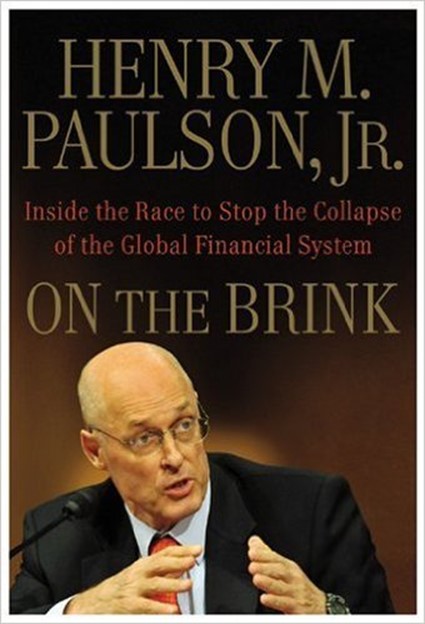
The financial crisis of 2008 has always been of immense interest to me. It was a classic case of how complex financial engineering based on extensive greed brought the world to its knees. Several multi-national financial institutions that had straddled the business world for over 100 years came crashing down within a few months, dragging with it the financial systems of several countries and causing a world-wide meltdown. The after-effects of the same have reverberated every stronger. Henry (Hank) Paulson was absolutely at the centre of it as the US Finance Seceretary as he tried to navigate the huge tidal waves that seemed to swallow everything in its strides. In some sense, I used to think that this Paulson’s way of paying for his karma having been at the helm of one of the main players in this vicious game, Goldman Sachs as its CEO for quite some time. This book is Paulson’s first hand information of the headwinds that he faced and how he navigated the system through its turbulence. It has a very differnet tone vis-à-vis the other biographical works that I have read in the past.
Paulson, true to his image comes across as a “straight from the gut” author who is expressing his views/biases in his book as opposed to just putting out the “politically right” tones. A significant portion of the content is published as a day by day view of how things developed in 2008. As he himself says that he is getting his thoughts from memory as opposed to memos/other records that he has researched and the book definitely reflects the same. Further it also gives a good insight into how the congressional game played out over those torturous months and also the impact of the Obama-Mccain election on the turmoil. Paulson is also quite direct in his assessment of the different players involved includign the erstwhile president Geroge W Bush. In fact, if Bush is very close to the person whom Paulson portays him to be, he does come off as a very sensible, practical and decisive leader. However considering Paulson’s republican affiliations and that Bush was a big supporter of Paulson’s policies (which in his own words went several times contradictory to his life long held values) does reek of cognitive bias towards his boss.
Paulson begins with a brief/direct reflection of his formative years,covering his modest and hard-working family backgrounds, the stint at Harvard, his beliefs around Christian Scientology, his initial job under the Nixon adminstration before joining Goldman Sachs in 1974. His rapid rise at the bulge-bracked Investment bank is also covered in reasonably quick detail including the well chronicled takeover from his predecessor John Corzine. What he doesn’t cover however is his own involvement as Goldman built up a portfolio of Mortgage-based toxic assets and financially enginereed them into Collaterized Debt Obligations (CDOs), Credit swaps which insured the cash flows of these complex products (and which bought down the largest American Insurer, AIG) and in fact pioneered the movement. He also doesn’t delve upon the tax benefits that he received when he sold his shares in Goldman to become the Finance Seceratary.
Once you get past the initial chapters, the book proceeds at a break-neck speed on the events that transpired in 2008 starting with the short runs of the Government Sponsored Enterprises (GSEs) – Fannie Mae and Freddie Mac, the collapse of Bear Sterns, the congressional nod to Paulson with which they took over the GSEs, the collapse of Lehman Brothers, the gargantuan efforts to save the remaining bulge bracket firms (Merill Lynch, Morgan Stanley, Citibank and Goldman Sachs), AIG and then the TARP plan which rescued the system through capital infusion but in the process made them TBTF (Too Big To Fail). Also the mindlessly hurried acquisitons of Wachovia, Washington Mutual etc., which were neccessiated to save them in some form. The detailed description of the events and the key partners-in-crime with Paulson which included among others, Tim Geithner (who would ultimated succeed him as Secerataty of Finance under Obama) and at that time headed the New York unit of the Federal Reserve Bank, Ben Bernanke, the governor of the FED and his handpicked subordinates (several of them were ex-Goldman) provide an excellent insight into the challenges that public policy officials face in their thankless jobs. The various politics that were involved includign the dyanmics between and within the Republican/Democratic causeses are nicely articulated from the eys of a man who was in the field as opposed to it being a systematic 3rd-party chronology like how Andrew Ross Sorkin depicted in his book “Too Big To Fail“. What also comes through are his strong relations with China and the impact of everbody in the global economy being in everybody’s else pockets and how the moral lines of ethical banking practices have really gone out of the blue over the last 2-3 decades of innovations in financial engineering. Paulson ends the book by mentioning that his belief in free and open markets still remains and that is sheerly because there is really no other viable atlernative.
While I can resonate with Paulson’s decisions (which he himself agrees went against his principles) and the constraints under which he had to operate, it is quite ironical that the guy who believes in free markets and not lecturing on moral hazards finally had to bailout the same corporations that caused this disaster in the first place. In my view, the stand that he took against Lehmann was right but the short-sightedness of leaders who want quick fixes prevented him from continuing further. One does shudder to think of what would have happened had the entire system collapsed but then the prevention of the collaps has just added layers on an edifice whose foundations are at best shaky. The visionary in me would argue that it is no gain without pain and Paulson and his contemporaries lost an opportunity to correct the horrible errors of the past and repalced it with TBTF organizations. But then the realist in me would argue as to how easy it is to profess when you are nowhere going to be in that hot seat.
As I was reading through the same, I was hoping that somebody (maybe Urjit Patel or Shaktikanta Das) whould one day chronicle the challenges that they faced in 2016 when the honorable Prime Minster of India launched one of the biggest ever social experiments in India – Demonitisation. I strongly recommend this book to anybody who is interested in understanding the dynamcis of how politics and commerce intertwine in today’s world and how the different players (who are among the world’s sharpest minds) react and respond to the same. It is indeed a chronicle of somebody who has seen action from the frontlines.
 Experiential Musings
Ram, your thoughts on GST is expected in your next post