
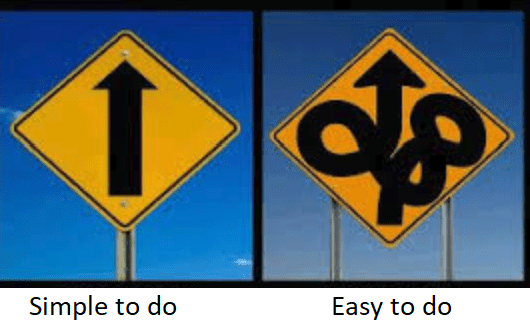
In the increasingly scary fast paced world of today, every person finds himself or herself having to take numerous decisions every single day. Several of these are very transactional ones where the options chosen don’t matter much (where to eat during lunch time, for instance) but there are several which have far more long-lasting impact. In my personal experiential view, there are 2 aspects to every decision. How does one decide and How does it get implemented? In this article, let us focus on the former. Over the last few years, as I have started listening to the inner voices in a more systematic manner thanks to practices like Sandhyavandanam and Vipassana, 2 very concrete patterns have emerged.
- The ability to be truthful with one’s self and thereby the ability to accept things as part of a larger scheme of things (Some would call this as acceptance of one’s karma)
- The ability to listen to the inner voices especially when having to take a decision. From what I have comprehended thus far, I almost always seem to hear 2 sets of voices (one from the head and the other from the mind)
Further building on #2, the voice from the head is always clear, objective and seems to favor the option that is the right thing to do. On the other hand, the voice from the mind is muddled, emotional and seems to favor the option that is the easiest thing to do. Now there is a 3rd hybrid voice which initially takes the decision to go the mind way but recoups in a bit to do a course correction. However, the hybrid voice doesn’t always come to the front. Let me illustrate with a simple example.
You have set the alarm to wake up early (say 5:00 AM with the snooze option of course). As the alarm goes off, both the head and the mind go to work as follows:
Head (right thing to do): Get up and handle the day as you have planned.
Mind (easy thing to do): Come on, sleep for a little while longer. You can always get up early tomorrow. At the minimum, press the snooze button.
Hybrid voice (at about 5:30 or after the 4th or 5th snooze): hey man, enough, get up.
Now if we extrapolate this to a slightly more serious scenario where you go to a government office and a corrupt official demands a bribe for delivering a service. Here are how the inner voices may play out
Head (right thing to do): Don’t do this immoral thing. Find out a proper and legal way to get this done.
Mind (easy thing to do): Come on, it is after all a small payoff. Let me pay the bribe and get things sorted out quickly.
Hybrid voice (at some point in the future): Why did you do this? Was it right to have done this? Do you have to enjoy this benefit by doing this? Make amends.
Interestingly, over the years, the easy way to get things done has become a justified way of behaviour by euphemising it as practicality. The number of options of doing things the easy way has increased manifold and have created a huge clutter of mediocrity which hides the inane goodness that comes with doing things the right way. Which brings me to the point of the conflict between simplicity and ease
- Simple things are rarely easy and almost always come from the head. They are clear, objective and help clear clutter. They are difficult to do but will last longer and will be of high quality. Most importantly they will take time and require the positive ingredients of patience, clarity and flawless execution to make. A classic example is the Google search interface which has made life to the user so simple to search and find information. I still remember the horrible interfaces by Altavista, Bing and Yahoo to quote a few.
- By contrast, Easy things by definition are easier to do. Typically, these are short cuts, tend to be myopic and pea brained. And in several cases, they become complicated and twisted and thereby add to clutter. And almost always, result in poor quality leading to rework. And typically, most easy things require very little time to do. Several complicated IT systems today are a result of this kind of thinking. Firms invest millions to build complex systems and then spend even more to simplify them. My favourite analogy is the ease of dropping a beautiful saree on a pair of sharp thorns. Very easy to do. However, taking it out of thorn bush without ruining the fabric, albeit simple is quite hard.
- Paradoxically, once simple capabilities or skills are obtaining using them becomes easy. However most easy things become extremely complicated to use.
Another classic example that we see all around us and which is a significant side-effect of our fast-paced lifestyle is work life balance. It is hard to maintain a good work life balance but exceptionally easy to live an in-disciplined life. And several of us indulge in this craziness by quoting convenient excuses like career growth, intellectual superiority, corporate glory etc., all again in the name of practicality. Starting with those of us who are in our 40s, this imbalance comes back to bite us in more ways than one.
Another interesting case of this tussle is the clutter in the field of parenting. While every parent verbally states that they don’t want to stereotype their children, that is exactly what we end up doing because it is the easiest thing to do. Nurturing a child to help identify its passion is the right thing to do but is seldom easy. Bullying the child to do exactly what the parent wants is the easiest thing to do. Of course, it is practical to stereotype the child into following the staid curriculum. And while hundreds of studies confirm that EQ is more important than IQ, tons of effort are spent in IQ building activities. Why? Because it is easy to do. How much time do we spend in fostering qualities like objective problem solving, humor, ability to respond, humility, empathy etc., to these fresh minds? Hardly any because to do that, we as parents have to learn to do it ourselves. Which is of course hard to do? There is enough material out there which convey the strong message that “Children don’t listen to their parents. They follow what their parents do”. But then it is always easy to preach than practice, isn’t it? I loved the key messages conveyed in the 2016 Tamil movie Appa which, despite its obvious cinematic dramatizations conveyed the following message quite effectively on modern-day parenting.
When will we stop judging the fish by its ability to climb a tree?
The same principle holds quite strongly in the professional world as well. One of the most popular problem-solving methods that is in vogue today is Design Thinking. Having been a DT practitioner for several years, what strikes me is the most important part in DT is the first phase. This is called “Empathize“. It is about the ability to carve out the definition of the problem in a clear, objective and sensible way so that the solution comes out as a natural by-product. The foundations of DT can be summarized in the following 2 cliched but profound quotes
- “After you have eliminated the impossible, what remains, however improbable is the truth” – Sherlock Holmes, arguably the most objective and clear headed literary character ever created.
- “Defining the problem is half the problem solved. Once you define the problem well, the solution takes care of itself”. I had written on this, a few years ago.
There are of course cases where the voices from the head and the mind are perfectly aligned. When one pursues one’s passion or interest without Fear of Failure (FOF). A perfect sync between what is the right thing to do and what is easy (because one always enjoys one passion and so it becomes easy). This typically lasts till one begins to focus on the results of pursuing one’s passion (rather than just the joy of pursuing it) and in which case other less altruistic pursuits come into play. To quote an example, if I enjoy playing a game, there is perfect alignment. The minute, I start playing the game to achieve certain goals (like playing for a premier league or for the country), then things become more complicated.
This is exactly where Spirituality comes in. Spiritual training is about building the ability to condition the mind and get it to be perfectly aligned with the voice in the head. And this by definition, requires a gradual withdrawal from materialistic pursuits and focusing towards more altruistic pursuits. It is all about having the humility to empathize with the inner self and thereby making things Simple. However that is definitely not Easy.
 Experiential Musings